Use Case · Student Lecture Notes (Dicty Pro)
Turn recorded lectures into structured study notes. No more writing by hand.
Stop struggling to keep up with fast-speaking professors and messy handwritten scribbles. With Dicty Pro, drop any lecture audio (.mp3, .m4a, .wav) or video (.mp4, .mov) into Dicty for full verbatim transcription, then let AI instantly summarize key takeaways, extract formulas, and generate exam study questions.
Writing down complex lectures by hand forces you to split focus between understanding difficult concepts and frantically scribbling notes. You end up with gaps in your notebook, missed explanations, and messy handwriting right before exam season.
Record the lecture on your phone or laptop, drop the audio file into Dicty, and get a complete, accurate transcript in minutes. Then ask local or cloud AI to structure the lecture into clear chapters, core definitions, and exam flashcard questions—unlocked with Dicty Pro without file length limits.
How it works
Simple 4-step process.
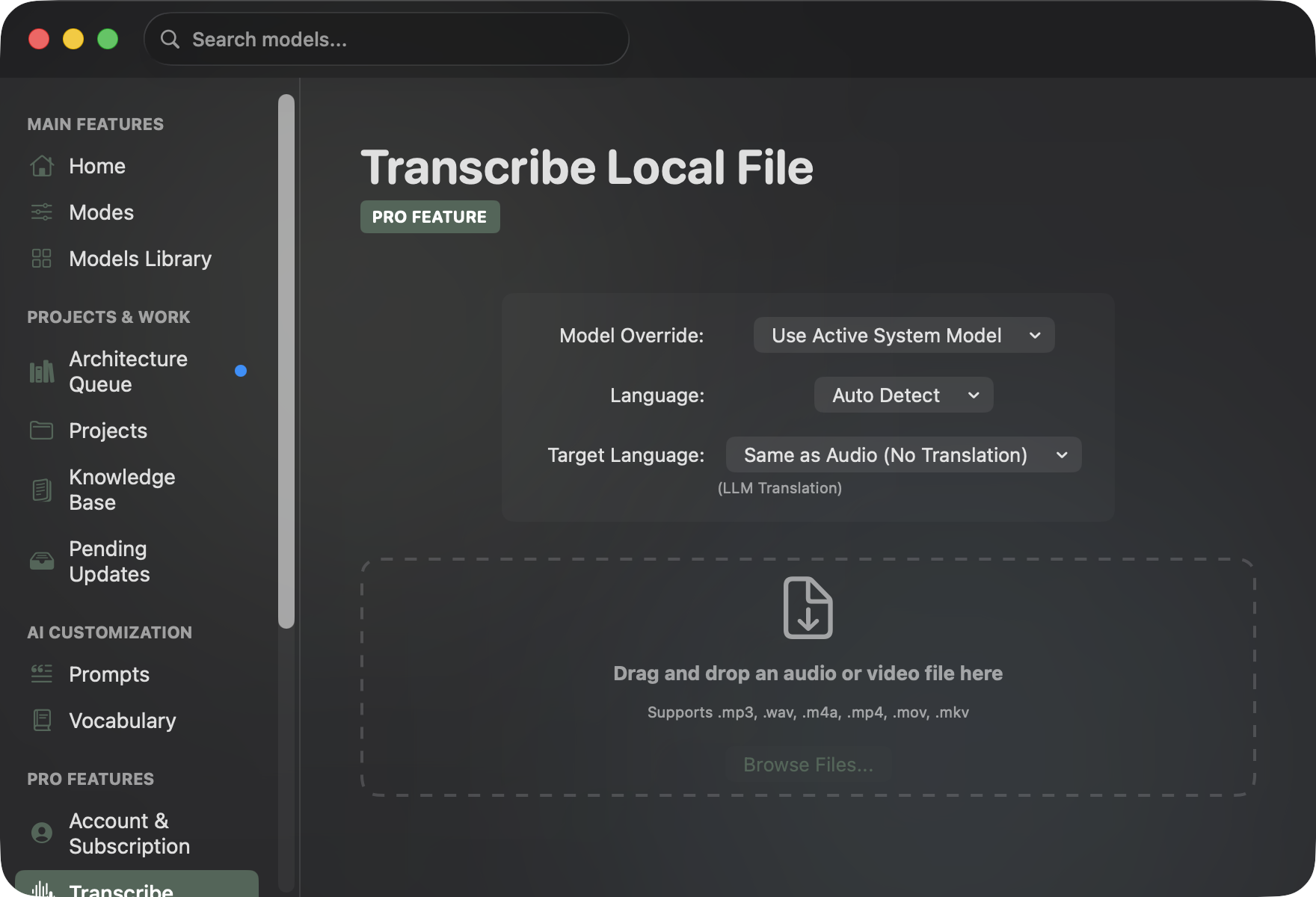
Drop your lecture recording
Import any audio or video file (.mp3, .m4a, .wav, .mov, .mp4) from your phone voice memos, dictaphone, or online class recordings.
Fast local Whisper transcription
Dicty runs on-device Whisper models with Metal GPU and AVX2 hardware acceleration, transcribing multi-hour lectures without cloud fees or audio cutoffs.
AI summarization & key points
Use local Ollama or cloud LLMs to distill the lecture into concise bullet points, core concepts, formulas, and exam prep Q&As.
Export to Obsidian, Notion, or Markdown
Copy clean, formatted study notes directly into your knowledge vault or print them out for revision.
Zero hand-cramps & full lecture focus
Pay 100% attention to the professor during class knowing every word is captured and transcribed accurately.
Instant AI summaries & exam study guides
Turn 90 minutes of spoken audio into organized chapters, high-yield cheat sheets, and flashcard-ready concepts.
Dicty Pro: Unlimited audio duration
Transcribe multi-hour seminars and entire semester archives with no 10-minute file caps and complete privacy on your laptop.
# CS224N: Lecture 04 — Self-Attention & Transformers

## 🎯 Key Takeaways
- Recurrent networks (RNNs) suffer from O(N) sequential computation bottleneck.
- Self-attention enables O(1) sequential operations via Query, Key, Value matrix projections.
- Multi-Head Attention allows attending to information from different representation subspaces.

## 📝 Core Formulas
- Attention(Q, K, V) = softmax(Q K^T / sqrt(d_k)) V

## ❓ Exam Review Questions
1. Why do we divide by sqrt(d_k) in scaled dot-product attention?
2. How do positional encodings preserve token order in permutation-invariant architectures?
Stop writing docs. Start speaking them.
More use cases
Architecture
Architecture Decision Records that write themselves.
Learn morePull Requests & Code Changes
Say what you changed. Your PR writes itself.
Learn moreTeam Enablement
Onboarding docs that stay true to the codebase.
Learn moreOutage & Bug Reports
Something broke? Say what happened out loud. Report done.
Learn moreReal-Time Translation
Speak in your language. Dicty types in English instantly.
Learn moreDeveloper Workflows
Speech-to-Text for Coding, VS Code & Terminal
Learn morePersonal Knowledge Management
Voice Notes to Markdown for Obsidian Vaults
Learn moreTranslate Text to Voice on the Fly